Friday, October 11, 2013

Something Smells Fishy- Overcoming Misconceptions about GMO's


AquaBounty Technologies applied to the FDA for formal approval of their transgenic salmon, AquAdvantage Salmon, in 1995. It is now 2013 and they are still waiting to hear the verdict. So what exactly are these transgenic salmon and why are they not available on the market even after eighteen years of waiting?

AquAdvantage fish are genetically modified Atlantic Salmon that grow much faster than their unaltered brethren. Usually, Atlantic Salmon only grow in the summer, when the warm waters trigger the production of growth hormones. Scientists at AquaBounty, however, found a way to promote the production of these hormones no matter what the season. They located a promoter, a sequence of regulatory DNA, in ocean pout (an electric eel-like fish that thrives in icy waters) that is turned on in cold temperatures. Once turned on, the promoter activates what ever gene follows it. By linking this cold-triggered promoter to the gene for growth hormone in salmon, AquaBounty created AquAdvantage Salmon-- fish that would grow twice as fast as the naturally occurring Atlantic salmon.

These genetically modified fish bring about both economic and ecological benefits. As Bryan Walsh points out in his article in TIME Magazine, "Frankenfish: Is GM Salmon a Vital Part of Our Future", the U.S. currently gets much of its salmon from abroad because of the lower cost. Shipping in fish from other countries means we are leaving behind a large carbon footprint in the form of fuel guzzling ships. Ronald Stotish, CEO of AquaBounty, believes that AquAdvantage fish would allow the U.S. to significantly reduce this carbon footprint by growing "salmon in land-based systems [at home], raising fresh seafood close to where it's needed".
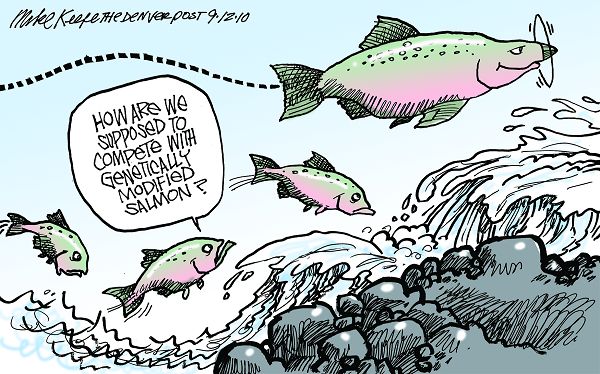
Cartoon courtesy of Mike Keefe

Though the FDA concluded that these fish are safe to eat and pose no substantial impact on the environment, they have yet to approve them for sale on the market. One hindrance is the fear of the negative effects they may pose on wild salmon populations if they happen to escape. AquaBounty, however, ensures that it will take all necessary precautions to make sure that never happens. In her book, Frankenstein's Cat: Cuddling Up To Biotech's Brave New Beasts, Emily Anthes reveals that AquaBounty will breed their fish in secure facilities, raising them in confined tanks away from their natural environments. As an additional precaution, "the company also plans to produce only sterile female fish-- incapable of passing their genes on even if they did somehow end up on the lam" (Anthes, 24).

Despite these efforts, AquaBounty still has its fair share of critics as some supermarkets claim that they will not stock AquAdvantage salmon even if the FDA approved them. Andrew Pollack discusses this issue in his article for the New York Times titled "Grocery Chains Won't Sell Altered Fish, Groups Say". In this article, Pollack reports the opinions of some of these chains including Aldi, whose spokeswoman states that Aldi's "current definition of sustainable seafood specifies the exclusion of genetically modified organisms". According to Pollack, other critics believe that the fish hasn't been safety-tested enough to be sold commercially and that the public won't want to eat it. When the FDA has stated that these fish "would be as safe to eat as conventional salmon", I have to wonder if these critics' fears are fueled more so by unease towards the world of genetic engineering than by health and environmental concerns. 

Movie Poster for the 2004 film Frankenfish via IMDb

Frankefish is a film about genetically engineered Chinese snakeheads who roam around in Louisiana swamps, terrorizing and murdering locals. "Frankenfish" is also the nickname critics have given to the AquAdvantage salmon. This is just one example of how genetically modified organisms (GMO's) are portrayed in popular media. With countless other sci-fi movies and novels depicting GMO's in such horrific colors, it is no wonder that the slight mention of "genetic engineering" has many cowering in the corner with fear. Just look at the effect GloFish, the genetically modified zebrafish made to glow under fluorescent light, had when they were first created. The internet was plastered with stories making these harmless fish seem like "monsters, harbingers of some sort of ethical or scientific apocalypse" (Anthes, 26). Eventually, GloFish did find approval and can now be found in pet stores and homes all over the country. They have done absolutely no harm and are loved by the customers who purchase them. Now that GloFish are so widely accepted, it becomes apparent how unfounded those initial fears and apprehensions were.

If we don't work on shattering these misconceptions, we could be missing out on a lot of good. While it is true that GMO's have their own sets of risks and dangers, they also have many benefits. Take Artemis as an example. She is one of many transgenic goats created by James Murray and Elizabeth Mega whose milk produces lysozyme, an enzyme that destroys the bacteria responsible for many gastrointestinal problems plaguing underdeveloped countries. According to Anthes, "more than 2 million children [die] of diarrheal disease every year" (36). The milk from these goats could change that, saving countless lives, if only they could get approval from the FDA as well as the doctors and patients who would benefit from it. As Anthes states, it is "appropriate for an animal intended for human consumption to be subjected to a higher level of scrutiny, but the end result is that these organisms can get stalled in a never-ending regulatory process" (39).

AquAdvantage fish have been stuck in that process for eighteen years. Their rejection by the FDA would be a major set-back for the world of GMO's, discouraging scientists from taking on future genetic engineering projects. This would be a shame. We know of the economic and ecological advantages that AquAdvantage fish pose for the U.S. as well as the health benefits of transgenic goat milk. These are only two examples of how genetic engineering could change our lives. Just imagine how many more possibilities are out there just waiting to be discovered-- possibilities that may never see the light of day if we don't deconstruct the biases surrounding this branch of science. So, while the nation eagerly awaits the FDA's verdict, we need to work on educating the general public on the true nature of GMO's, breaking stereotypes so we can learn to see both the good and the bad that these organisms can bring to our world.

Sources:
Anthes, E. (2013). Frankenstein's Cat: Cuddling up to Biotech's Brave New Beasts. New York: Scientific American/Farrar, Straus and Giroux.
Pollack, A. (March 20, 2013). "Grocers Won't Sell Altered Fish, Groups Say". NY Times. Retrieved Oct. 11, 2013 from http://www.nytimes.com/2013/03/20/business/grocery-chains-pledge-not-to-sell-modified-salmon.html?_r=0
Walsh, B. (July 12, 2011). “Frankenfish: Is GM Salmon a Vital Part of Our Future?”. TIME Magazine.  Retrieved Oct. 11, 2013 from


Can Cloning Save Endangered Species?


Cloning is a very controversial topic in the science world. Some justify animal cloning, because it might someday help us in curing human diseases and cancers. Others say animal cloning is unethical and cruel punishment for the animals, especially considering that cloning is of no benefit to them. However, what about if the cloning is beneficial for the animals? What about if the cloning can save endangered species from extinction? 

            The debate about these questions will linger on as long as we are alive on this planet. There will always be two sides: one side supporting cloning as it can be of benefit to humans and animals alike, while there will be others against biotechnological advancements, such as cloning no matter what. Regardless of all the controversy, I believe cloning can be beneficial especially with the intent of preserving rare wildlife. 


            The book talks about ways of preserving certain species those are in danger. The story of Noah comes to mind, as the animal was the very first endangered species clone. Noah is an identical copy of a rare wild ox, which made headlines in 2001, when his birth shed some light on whether it is possible to clone endangered animals for the purpose of preserving them. A little more then a day after he was alive, Noah became sick and was dead within two days. Researchers at Advanced Cell Technology said, "Cloning had nothing to do with Noah's death, but it is tough to say this for sure especially considering all prior animals that have been cloned have had serious health issues. While Noah's death was sad to see, was the intent behind his cloning completely wrong? Through Noah's death, scientists are better able to understand the challenges of cloning and could potentially be able to eradicate their mistakes, but we also are able to understand one more thing "Cloning these rare animals is about more than money or companionship—it’s about survival."
            Now the question is can science help preserve endangered species from going extinct. In Frankenstein’s Cat, Betsy Dresser says on the topic, "The prospect of using cloning to save endangered species is a big dream, one that will require many researchers and many years to pull off." However, Emily Anthes says, "“… To many biologists, cloning is all sizzle and no substance, a high-tech spectacle that fails to address habitat loss, poaching, pollution, and the other human activities that put wildlife at risk in the first place…" On one hand we have Dr. Betsy Dresser saying cloning can be beneficial but from the quote above we see Emily Anthes saying in essence "human beings are the ones making animals endangered species". 
            In Brazil the Brazilian Agricultural Research Corp. and the Brasilia Zoological Garden set up a project in which they began collecting samples of sperm, blood, umbilical cord cells from wild animals. The two groups collected tissue samples of over 420 species of many endangered, rare species all in the hope of cloning them. The article brings up some good points, many of these animals are in danger because of human beings destroying their ecosystems and hunting them. Why should we bother saving these samples and cloning these animals when there is less than a five percent success rate? The article mentions that cloning is not feasible because cloning, simply put has not been successful. In addition, the article mentions current cloning techniques are just not effective and won't make much of a difference. 
            The article talks about why scientists think cloning can be very successful but the reality of the matter is that since cloning of endangered species began there have been no successful clones, as all the clones have died prematurely and those that lived to be alive died before adulthood. Another important thing to keep in mind is that a lot of pregnancies must be done before a successful clone is even born. Yet, researchers and scientists alike are holding out on the hope that cloning will be able to revive endangered species as well as increase genetic diversity once again. Martha Gomes says, "I'm not saying cloning is going to save endangered species," Gomez says, "but I am still a believer of cloning as another tool. It's not easy, though. The research moves slow."


WORKS CITED

Anthes, Emily. Frankenstein's Cat: Cuddling up to Biotech's Brave New Beasts. 1st. Edition. New York: Scientific American, 2013. Print.

"Will Cloning Ever Save Endangered Animals?: Scientific American." Will Cloning Ever Save Endangered Animals?: Scientific American. N.p., n.d. Web. 11 Oct. 2013


Grocery Chains and the Consumption of Genetically Modified Organisms

                The Time magazine article “Grocery Chains Won’t sell Genetically Modified Fish,” by Alexandra Sifferlin, describes the attempts of many popular grocery chains to boycott of selling genetically modified organisms.  Sifferlin describes how approximately 2000 stores have united under the Campaign for Genetically Engineered-Free Seafood to keep fish that have been genetically modified out of the grocery store.  Popular grocery stores such as Aldi and Trader Joe’s are a part of this campaign.  This effort stems from the argument that the organisms with altered genomes are not safe to consume by humans or safe in ecosystems globally.  This boycott and the ideas the campaign represents has especially hurt the company Aquabounty, the creator of genetically modified salmon.
                Emily Anthes, in her book Frankenstein’s Cat: Cuddling Up to Biotech’s Brave New Beasts discusses the issues that have undermined the sale of AquaBounty salmon.  Anthes has pointed out that the criticism that faces the Aquabounty salmon are from the unknown effects of the genetic modifications on human health the ecological impact an Aquabounty salmon would have on the environment if it was accidentally released. 
Anthes points out that ecologists are concerned that genetically modified organisms can be an invasive species due to their altered genes.  Aquabounty has made it clear that there are several security measures in place to prevent the Aquabounty salmon from becoming an invasive species. This includes placing the production facility outside of its habitable environment.  If released, the salmon would not be able to survive due to salinity and temperature levels.  Second, the salmon that are being genetically modified for human consumption are sterile females, giving absolutely no chance for its genes to become rampant in an ecosystem.
                In addition, the Aquabounty has gone to lengths to assure that genetically modified fish are not a threat to human health.  However,  Sifferlin states that the FDA research showed that although there was no risk to people with fish allergies it had the potential to induce allergies. 
                Even with the support of science and its dedication to keep the genetically modified salmon isolated from the ecosystem, it still faces problems from the public’s perspective on genetically modified organisms.  According to recent polls, most Americans believe that the FDA should prohibit the sale of genetically modified salmon (Sifferlin, 2013).  To make matters worse for Aquabounty, another survey showed that the more than half of Americans believe that science is cannot be the only way to assess genetic modification, but must also include moral and ethical factors (Anthes, 2013).  If the perception of genetically modified organism by the public and major grocery chains is that they are detrimental to health and ecology, then companies such as Aquabounty will continue to have a difficult time in the American market.

 
Sources:
Anthes, Emily. Frankenstein's Cat: Cuddling Up to Biotech's Brave New Beasts. New York: Scientific American, 2013. 13-32. Print.
Sifferlin, Alexandra. "Grocery Chains Won’t Sell Genetically Modified Fish." Time 21 Mar. 2013. Web. 11 Oct. 2013. <http://healthland.time.com/2013/03/21/grocery-chains-wont-sell-genetically-modified-fish/>.

No Need to Worry: Fluorescent Tadpoles on Patrol

Fluorescent tadpole in the presence of chemical contaminants


       Due to Lemkine's and Demeneix's lastest work in genetic modification, there is a new superhero in town: fluorescent tadpoles. With the ability to combat villains such as plasticizers, resins, and fumigants, these pint-size heroes measure up to Marvel's very own Thor and Captain America. In a recent article published in Scientific American titled "Unhealthy Glow: Fluorescent Tadpoles Expose Chemical Contamination", Erica Gies discusses a novel use of green fluorescent protein (GFP) to detect pollutants.

        GFP, as a bioluminescent protein derived from the jellyfish, Aequorea victoria, absorbs ultraviolet light and re-emits green light without any accompanying factors. Watchfrog, a Pharmaceutical and Environmental company, isolated the gene for green fluorescent protein and introduced it into the genome of Xenopus tadpoles. Specifically, the GFP gene was fused to genes responsible for thyroid functioning whose gene expression occurs in the presence of thyroid hormones. It is argued that chemical pollutants such as "insecticides, herbicides, fumigants, fungicides, detergents, resins and plasticizers" mimic the hormones, causing expression of GFP and subsequent fluorescence. To put it simply, these transgenic tadpoles glow green when exposed to chemical pollutants, protecting society from entering harmful waters. With a high demand to monitor unhealthy contaminants, the U.S. Environmental Protection Agency (EPA) has currently put these tadpoles to use. In cooperation with the EPA, Watchfrog has teamed up with Pathfinders, an EPA program, to further develop a miniscule device known as the FrogBox that records pollutant levels over time within the transgenic swimmer.

       In Frankenstein's Cat, Cudding up to Biotech's Brave New Beasts, Emily Anthes comments on the potential uses of green fluorescent protein as a means to visualize the expression of genomic DNA when coupled to specific sequences. She states, "GFP has become a valuable tool for geneticists. Researchers testing a new method of genetic modification can practice with GFP, splicing the gene into an organism's genome. If the animal lights up, it's obvious the procedure worked" (16). This fusion of foreign DNA with a host cell's genome is called a  transgene and characterizes transgenic organisms. Examples provided by Anthes include Atlantic salmon with a transgene for growth hormone created by AquaBounty, and goldfish with the introduction of GFP known as Glofish. As parallels to the examples, the fluorescent tadpoles have been received with hostility by the scientific community due to the harmful effects the contaminants have on the living detectors. Specifically, the pollutants disrupt the endocrine system of the tadpoles, affecting metamorphosis. At the same time, the transgenic organisms serve a greater purpose in protecting humans from such harmful contaminants.

        Anthes comments on these conflicting views referring to society as a "troubled middle" in which we understand the importance of using animals for medical research but at the same time do not support animal cruelty. To elaborate, Anthes mentions that "71 percent of Americans said that animals deserved some protection from harm and exploitation, an additional 25 percent said that animals should have the same rights as people.....and yet 64 percent of all respondents accepted the practice of using animals in medical research" (168). With advancements in biotechnology, this conflict between ethics and scientific ability will only become more and more prevalent. Is it justifiable to "play God" simply for aesthetic purposes? Is it moral to cause animals discomfort for the good of humanity as a whole? Such questions do not and will not have straightforward answers. The solution lies in evaluating each dilemma case by case. Anthes best summaries, "We'll have to carefully evaluate each application on its own terms, trying to balance what's in the best interest of the individual animal with what's good for species as a whole, for humanity and for the world that we all share"  (169).

References:

Gies, Erica. Unhealthy Glow: Fluorescent Tadpoles Expose Chemical Contamination. Scientific American, 7 Feb. 2013. Web. 6 Oct. 2013.
 http://www.scientificamerican.com/article.cfm?id=transgenic-tadpole-glows-to-reveal-chemical-contamination

Anthes, Emily. Frankenstein's Cat Cuddling Up to Biotech's Brave New Beasts. New York: Scientific American/Farrar, Straus and Giroux. 2013