Showing posts with label Emotion. Show all posts

Sunday, October 17, 2021

The Importance of REM sleep in Processing Traumatic Emotions and Using Music Therapy to Enhance REM Sleep


The concept of dreaming has been explored by humans over the test of time- in methods both abstract and scientific. For the large majority of human history, dreaming was seen as mystical and often associated with some form of divine intervention. However, newer research gives us more direction in the physiological purpose of dreaming, along with newfound methods of studying this phenomenon. In “Real-time dialogue between experimenters and dreamers during REM sleep,” Konkoly et al. explore different studies which suggest the dreamers in REM (rapid eye-movement) sleep retain many more cognitive abilities than previously assumed. Among these abilities, includes lucid dreamers being able to communicate with researchers in real time during REM sleep. While on a very general level, REM sleep is associated with mood regulation and memory consolidation, although the actual mechanisms of this require much more investigation. Konkoly’s research opens up many possibilities to future studies regarding REM sleep, through this method of communication with lucid dreamers during REM sleep. 

The effects of REM sleep are studied in “Restless REM Sleep Impedes Overnight Amygdala Adaptation,” where Wassing et al. found that poor REM sleep is associated with a decreased ability of the amygdala to process emotional memories during sleep. This somewhat unconventional study recorded participants singing karaoke while wearing muffled headphones, preventing them from hearing their own voices. Inevitably, their singing voices tended not to match the tune of the songs (“Silent Night” and the Dutch national anthem). When researchers played these recordings back to participants, greater activation in the amygdalae of these participants suggested feelings of shame after hearing these poor singing performances. For participants that experienced restful sleep after this first day of research, the amygdala response was lessened after hearing their singing the next day. However, for participants who experienced restless sleep (poor quality REM sleep monitored by electroencephalogram (EEG)), their amygdalae were just as sensitive, sometimes more, when hearing their singing during the next day of research. This study suggests that REM sleep plays an important role in processing memories overnight, especially these negative emotions of shame and embarrassment associated with the amygdala. Furthermore, those suffering from REM sleep disorders may be more susceptible to psychological disorders such as depression, anxiety, and post traumatic stress disorder (PTSD). 

There are many potential therapeutic applications within the intersection of these studies. From Wassing’s research, the importance of REM sleep is emphasized in regard to mood regulation, particularly after traumatic events and in those suffering from depression, anxiety, and PTSD. By employing the communication methods investigated by Konkoly, further strategies can be developed to enhance the quality of REM sleep, potentially reducing the severity of psychological disorders, such as depression. Current research implicates that music therapy during sleep can be beneficial to adults suffering from depression (Lund 2020). This can be combined with the work of Konkoly by providing music therapy to lucid dreamers over the course of several weeks and months, which should provide measurable differences in amygdala activity in response to traumatic events. The goal of this practice would be to increase the duration and quality of REM sleep. This could be an essential therapeutic measure for treating depression, anxiety, and PTSD. Other therapeutic practices should be researched using Konkoly’s methods of communicating with lucid dreamers to enhance REM sleep, ultimately decreasing the severity of amygdala responses to traumatic events (Wasser 2017). 


Konkoly, K., Appel, K., Chabani, E., Mironov, A. Y., Mangiaruga, A., Gott, J., Mallett, R., Caughran, B., Witkowski, S., Whitmore, N., Berent, J., Weber, F., Pipa, G., Türker, B., Maranci, J.-B., Sinin, A., Dorokhov, V., Arnulf, I., Oudiette, D., … Paller, K. (2021). Real-time dialogue between experimenters and dreamers during rem sleep. Current Biology, 31(7), R352–R353. https://doi.org/10.2139/ssrn.3606772 

Lund, H.N., Pedersen, I.N., Johnsen, S.P. et al. Music to improve sleep quality in adults with depression-related insomnia (MUSTAFI): study protocol for a randomized controlled trial. Trials21, 305 (2020). https://doi.org/10.1186/s13063-020-04247-9

Wassing, R., Lakbila-Kamal, O., Ramautar, J. R., Stoffers, D., Schalkwijk, F., & Van Someren, E. J. W. (2019). Restless REM sleep impedes overnight amygdala adaptation. Current Biology, 29(14), 2351–2358. https://doi.org/10.1016/j.cub.2019.06.034 

Zimmer, K. (2019, June 11). Karaoke-sleep study links disrupted REM with poor memory processing. The Scientist Magazine®. Retrieved October 17, 2021, from https://www.the-scientist.com/news-opinion/karaoke-sleep-study-links-disrupted-rem-with-poor-memory-processing-66139. 


Wednesday, May 5, 2021

Your Nose May Be the Key to Your Past


The nose is a sensory organ that is necessary for one of the most, if not the most important senses in human beings and other animals. Without the sense of smell, our world and how we perceive it would be a whole lot different. Smell, also known as olfaction, is crucial for determining not only the food that we eat but also detecting if there is danger nearby, such as a fire. Smell is the only sense that is fully developed in a human fetus before birth. After being born, a child mainly detects and retains many smells they are exposed to and when the child grows up and is exposed to a familiar odor, detailed memories connected to that odor come flooding back. This familiar experience, which is no stranger to many people, is called the Proust effect, and has pushed researchers to delve deeper and to better understand the relationship between smell and memory.

Many researchers are trying to better understand the neuroscience behind how smell can impact memory, and one of those researchers is Laura K. Shanahan. In Shanahan’s lab, she and her colleagues focus on the influence of olfaction on memory consolidation in the brain of a sleeping human. As described in Shanahan’s paper, “Scents and Reminiscence: Olfactory influences on Memory Consolidation in the Sleeping Human Brain”, to better understand the relationship between odor and memory, Shanahan’s lab performs an experiment. Initially, participants are presented with an encoding task, such as matching a specific card with an odor to a location. After the completion of the encoding task the participants are told to go to sleep. The sleep is monitored in an MRI machine and when participants are observed to be in slow-wave sleep, the researchers present the participants with the odors that were involved in the encoding task. Upon waking up, participants were asked tested on the task they had done before sleeping which required them to memorize the card and location to the best of their ability. The results from this experiment showed that the subjects performed a lot better in the memory post-test when they were exposed to the odor stimuli during slow-wave sleep when compared to the results of the memory post-test of subjects who were not exposed to the odor stimuli during slow-wave sleep. The researchers also tried introducing the odor stimuli during other stages of sleep to determine if it had the same result, but they concluded that the memory-enhancing effect only occurred when the stimuli was introduced in slow-wave sleep. Shanahan’s findings have suggested that odors can greatly influence memory consolidation and that the results that came from experiment with sleeping human brain show how strong of a relationship olfaction has with the hippocampus.

In an article titled, “Why smells bring back such vivid memories”, Ana Sandoiu writes about the phenomenon that occurs when a familiar odor is detected and how research regarding the relationship between olfaction and memory can help better understand Alzheimer’s disease. In the article, Sandoiu begins by talking about a famous French author by the name of Marcel Proust who wrote pages of memories that was triggered by the smell of Madeleines. The writings of Proust help describe how odors can be connected to very detailed long-term memories. The Proust effect, which is described as the recall of episodic memories after an odor stimuli has been greatly studied and researchers have hypothesized the cause of this phenomenon to be due to the location of the olfactory system being very close the brain. The author highlights new findings that show “spatiotemporal information is integrated in a brain region known as the anterior olfactory nucleus (AON), which is implicated in Alzheimer’s disease” (Sandoiu). A researcher by the name of Afif Aqrabawi conducted a study in which mice were subjected to a range of experiments and tests to examine the role of the anterior olfactory nucleus on memory. In the article it states that Aqrabawi’ s study led to the discovery of neural pathways between the hippocampus and the anterior olfactory nucleus. In the experiments, mice were presented with odors and Aqrabawi says that when the neural connection between the hippocampus and AON is intact, the mice preferred spending time smelling a new odor instead of a familiar one. With the neural pathway disrupted, mice preferred to smell the familiar odor as they thought it was a new odor. Aqrabawi explains how this observation helps to better understand the neural circuits that are responsible for episodic memory triggered by smell. The article also talks about how Alzheimer’s disease has shown early degradation of the anterior olfactory neuron and that the odor deficits that are experienced by people who suffer Alzheimer’s have difficulty remembering details about the odors they encountered. The neural pathway that was discovered in Aqrabawi’ s study may be a clue to better understand what the underlying causes of this are.

The research being done by Shanahan, and the study done by Aqrabawi that was described in Sandoiu’ s article, shows the deep connection of the olfactory system and memory. The experiments done in Shanahan’s lab show how even during sleep olfaction can be used as a tool to shape memory consolidation. The olfactory pathway is connected to the limbic system, which is involved in memory and emotion and during sleep, odorants can be presented to individuals without them being aware and awake. Even without participants being actively awake, it reinforces the encoding of memories. The discovery of new connections in Aqrabawi’ s study greatly helps get closer to explaining why odors are so involved with memory. Further research in the relationship between odor and memory can possibly reveal methods that can be used in learning. This research can possibly be used to answer questions regarding if odor can be used to help better encode information in a shorter span of time. How can olfaction help in neurodegenerative disease and maybe in cases of amnesia? While there are many studies focused on the relationship between smell and memory, there is a lot yet to be uncovered.


__________________________________________________________________

Sandoiu, Ana. “Why Smells Bring Back Such Vivid Memories.” Medical News Today, MediLexicon International, 26 July 2018, www.medicalnewstoday.com/articles/322579.

Shanahan, Laura K., and Jay A. Gottfried. “Scents and Reminiscence: Olfactory Influences on Memory Consolidation in the Sleeping Human Brain.” Cognitive Neuroscience of Memory Consolidation, 2017, pp. 335–346., doi:10.1007/978-3-319-45066-7_20.


Friday, February 27, 2015

Psychopaths: Defining Who We Are By Our Neural Activity

By: Juan Pablo Moreno
            
           Throughout our lives we may encounter, maybe, someone who shares a particular personality trait with us; some one but hardly ever some two.  And even when we meet this person, we immediately realize that, despite our similarities, we are completely different people.  This should not surprise anybody, our unique neural structure changes and adapts with experience.  Yet, how then can we explain humanity’s natural tendency to expect a certain behavior out of everyone? No matter how terrible your week has been, you are expected to, at least, smile back to the annoying, old lady who randomly begins conversations with strangers at the grocery store – it’s the moral thing to do.  And this is it: No matter how unique the nearly seven billion people on this planet are, we are expected to be moral human beings who behave according to a universal rule of conduct.  We have a name for those who do not meet this expectation.  Throughout his book, The Psychopath Inside, James Fallon explores the biological factors that contribute to what we call a “psychopath.”
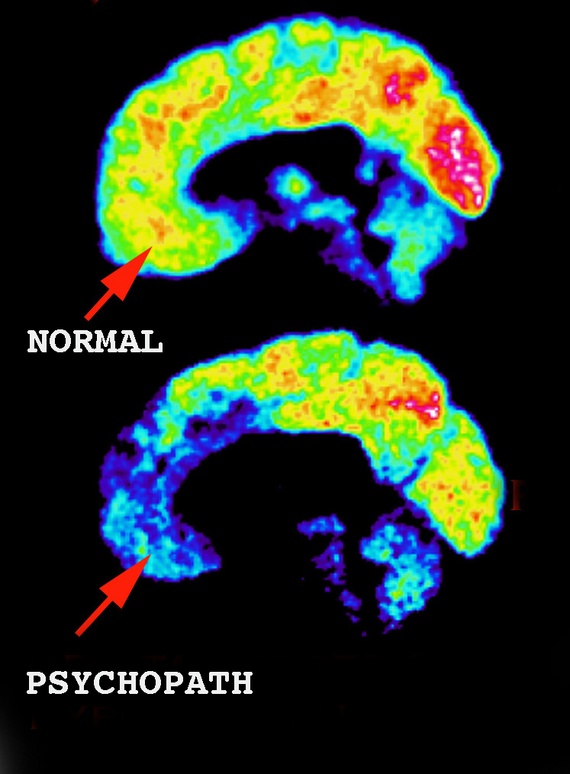
            I believe the main reason people act in similar fashions is due to “normal” – or common – distribution of neural activity.  Our minds produce unique thoughts due to its intricate and distinctive connections, yet these connections eventually form similar higher-order structures, or brain regions that, when used properly, produce the overall common human behavior.  James Fallon, an acclaimed neuroscientist who studied the brains of young psychopaths for years before ironically realizing his wasn’t too different, claims he can distinguish between a normal person and a psychopath by simply looking at an fMRI of his or her brain – more specifically, people’s neural activation patterns.  I read an article about psychopathy recently that also places importance on neural activity when discriminating between a normal brain and that of a psychopath.
            “Psychopaths' brains unable to fully process punishment” by James McIntosh from Medical News Today discusses some astonishing findings regarding psychopathy.  The article focuses on understanding why criminal psychopaths have a higher rate of recidivism and are practically immune to rehabilitation programs.  It mentions that in contrast to non-psychopathic criminals, psychopaths act in an emotionally detached, cold, premeditated manner.  Furthermore, it discusses a study that revealed that psychopaths have reduced brain regions “associated with empathy, moral reasoning and the processing of emotions such as embarrassment and guilt.”  It concludes that psychopaths do not respond to punishment because they judge based on the benefits of the situation without weighing the costs.
            In The Psychopath Inside, Fallon goes into great detail, coinciding with McIntosh’s notion that psychopaths have lower levels of brain matter in regions dedicated to morality and emotion.  Fallon discusses that lower activity in the orbital cortex and the ventromedial prefrontal cortex are characteristic traits of the fMRI of a psychopath.  These regions are involved in inhibition, social behavior, ethics, and morality.  Furthermore, psychopaths have lower activity of the emotion regulating amygdala, in the temporal lobe, which explains the cold behavior.  Overall, psychopaths lack significant amounts of activity to their limbic cortex, also known as the emotional cortex, for obvious reasons.
            Fallon’s explanation of the lack of activity to the brain helps understand the point McIntosh was aiming to make.  McIntosh mentions that psychopaths have difficulty learning from punishments and engaging in socially moral behavior.  The Psychopath Inside helps the reader understand this point of view.  Fallon does not write based on his scientific knowledge alone, he tells you how he, a self-proclaimed “pro-social psychopath” thinks.  For instance, he says he understands why one should go to his best friend’s mother funeral, but not because he feels the empathy, but rather because he was taught that it is the right thing to do.  He blatantly says it: “I don’t care,” using all CAPS and repeating it over and over as he writes about the many ways he can change to make happy those around him.  Punishment may serve as a way to tell a psychopath that what he is doing is wrong, but here’s the rub: he still does not care.  The whole idea behind punishment is “negative reinforcement,” used to make the person feel regret, but with no activity to this area of the brain, it is difficult to argue why punishments could work on a psychopath in the first place.
            McIntosh writes his article reporting on a study that attempts to find better ways to change psychopathic criminal behavior.  Fallon’s The Psychopath Inside provides an excellent tool for readers to understand what it is like to think like a psychopath.  In addition, it cannot be further stressed that psychopaths possess not only different neural networks but also larger – in this case smaller – neural bodies.  For this reason, one must take into consideration that we cannot expect the same success from methods that work to adjust a "normal" brain's behavior to result when applying them to the mind of a psychopath.  

Works Cited

Fallon, J. H. (2013). The psychopath inside: A neuroscientist's personal journey into the dark side of the brain. New York: Current.

McIntosh, J. (2015). "Psychopaths' brains unable to fully process punishment." Medical News Today. Retrieved from: http://www.medicalnewstoday.com/articles/288669.php